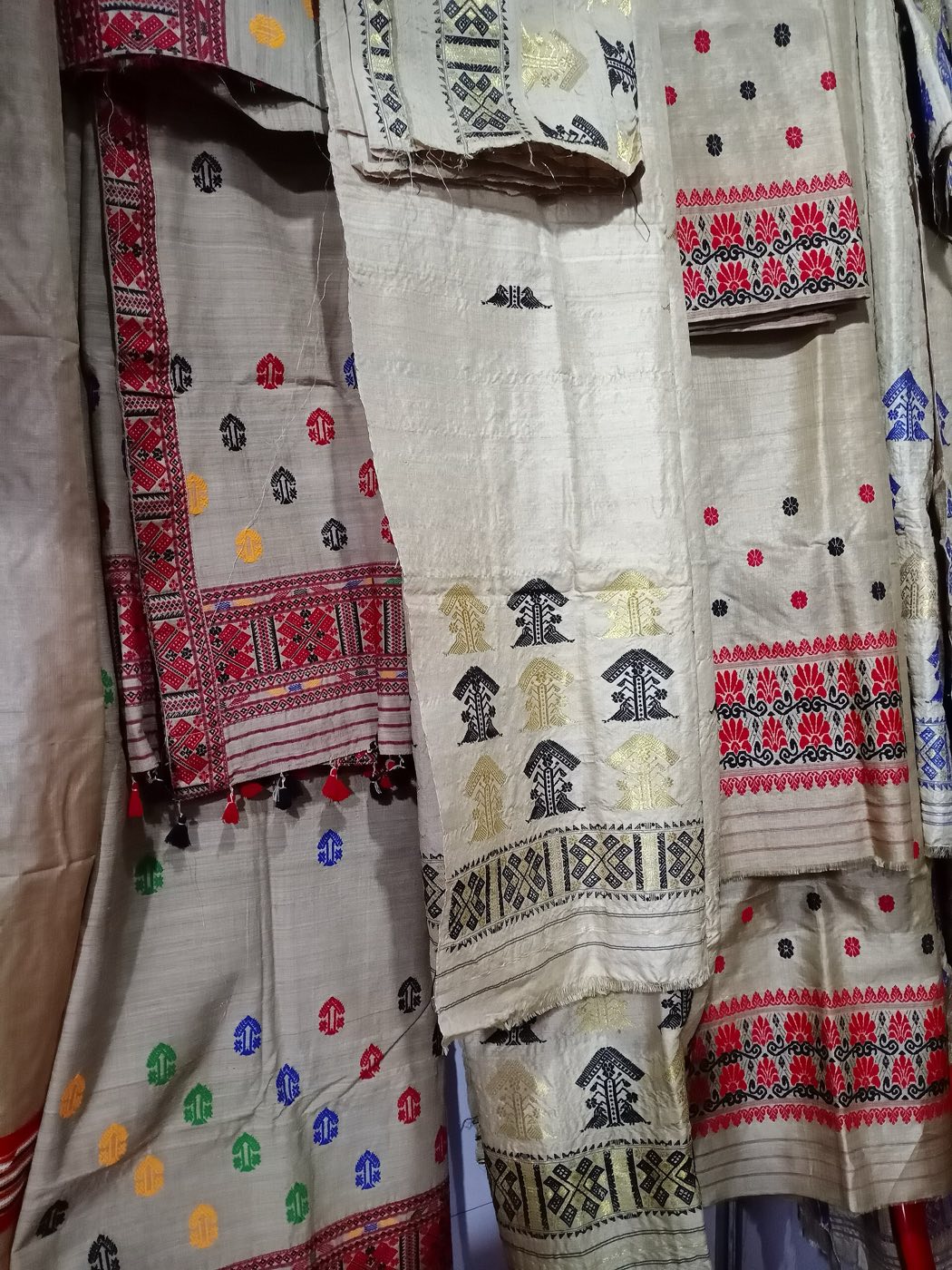
Hold a piece of real muga silk up to the light and it glows. The colour is a warm, natural gold, and nobody had to dye it. Muga comes only from Assam, and for centuries it has been the fabric of weddings, festivals and family heirlooms.
A silk found in one place
Muga is made by a silkworm called Antheraea assamensis. It lives in Assam and feeds on the leaves of local trees, mainly som and sualu. Unlike the mulberry silkworm, it is raised outdoors, on the trees themselves. That makes it hard to farm anywhere else. In 2007, muga silk of Assam received a Geographical Indication tag, which protects its name and origin.
Assam has two other well-known silks. Pat is a fine, shiny white silk from the mulberry silkworm. Eri is soft and warm, and is often called peace silk because the moth is allowed to leave the cocoon before the silk is spun.
Most fabrics fade with age. Muga does the opposite.
The village of looms
Sualkuchi, a town on the north bank of the Brahmaputra about 30 km from Guwahati, is the heart of Assam's silk weaving. In many homes there, you will hear the clack of a loom from morning till evening. Weavers make mekhela chadors, the two-piece Assamese garment, along with gamosas, saris and stoles. Visitors can often watch the weaving and buy straight from the makers.
How to spot real muga
- Colour: real muga is a soft gold, not bright yellow or orange.
- Shine: it has a natural, deep sheen that gets richer with age and washing.
- Feel: it is slightly stiff when new and softens over time.
- Price: pure muga is expensive. A very cheap "muga" mekhela chador is probably a blend or an imitation.
- Seller: buy from known weavers, cooperatives or government emporiums, and ask about the GI mark.
Caring for it
Muga is tough. Hand-wash it gently in cold water with mild soap. Dry it in the shade, and store it folded in cotton cloth. Treated well, a muga mekhela chador can be passed from grandmother to granddaughter, and it will look better at the second wedding than at the first.