On Wednesday, 14 October, the head of one of Assam’s oldest monasteries walked down to the edge of the Brahmaputra and looked at the water. Sri Sri Pitambar Dev Goswami is the satradhikar of Auniati Satra on Majuli. The river is cutting into Bhakat Chapori, a stretch of land near his satra. A meeting ground about a kilometre from where he stood is already gone.
He told reporters that 25 to 26 villages and several satras are at risk, including Auniati itself. “If the erosion continues, the entire Bhakat Chapori will be erased,” he said. A Rs 216 crore plan to protect the bank with giant sand-filled tubes has been sent to the state. If the government does not move, he said, devotees and villagers will start the work themselves after Kati Bihu.
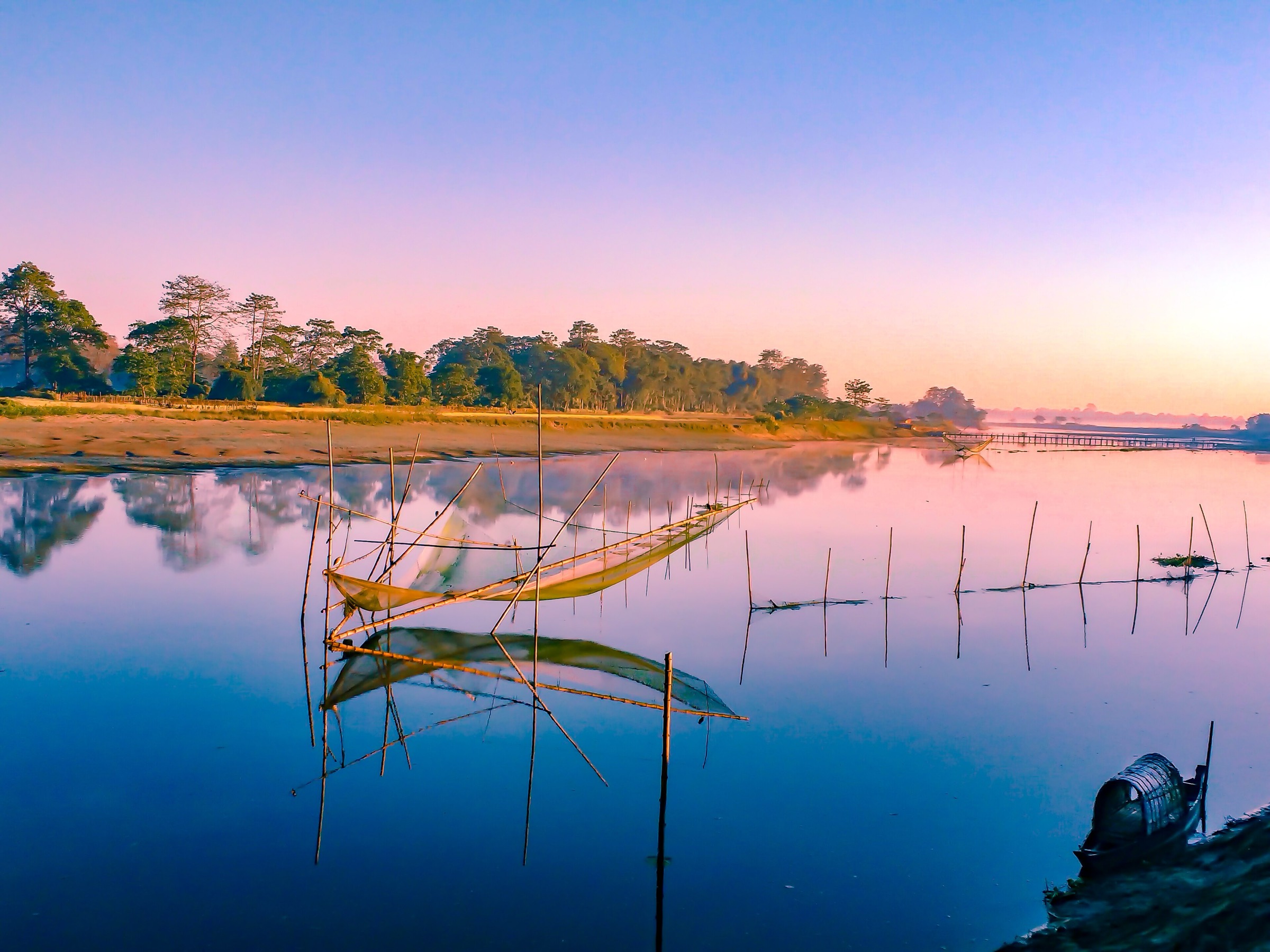
This is what life on Majuli looks like. It is one of the most beautiful places in India. It is also slowly being taken back by the river that made it.
An island that keeps getting smaller
Majuli sits in the middle of the Brahmaputra, across the river from Jorhat. It is often called the largest river island in the world. In 2016 it became India’s first river-island district. About 1.67 lakh people lived here at the 2011 census, almost all of them in villages.
The island was much bigger once. Government figures given to Parliament say Majuli measured 734 sq km in 1914 and 502 sq km in 2004, a loss of almost a third. Some older estimates put the island at around 1,250 sq km in the early 20th century. Researchers do not agree on the exact numbers, because they measure from different maps and years. They all agree on the direction.
Watch Majuli shrink
The island in 1914.
In 1914 Majuli was bigger than all of Greater Mumbai. By 2004 it was smaller. Island shape is simplified; sizes are to scale. Sources: government figures given to Parliament; Greater Mumbai area per the BMC.
The loss is not steady. A 2024 satellite study by the Central Water and Power Research Station looked at 120 km of river along the island. Between 1986 and 2023, about 75 sq km was washed away and about 58 sq km of new sand was laid down. The river takes in one place and gives in another. The trouble is that it takes old villages, farms and monasteries, and gives back bare sandbars.
What the river did along Majuli, 1986 to 2023
Net loss: about 17 sq km, and much of what came back is bare sand, not farmland or villages.
Source: Central Water and Power Research Station satellite study of a 120 km reach of the Brahmaputra, reported in The Assam Tribune, April 2025.
Much of today’s problem goes back to one night. The great Assam earthquake of 1950, magnitude 8.6, raised the bed of the Brahmaputra by a few metres. Big floods followed in 1951, 1954 and 1962. Wetlands dried up, streams changed course, and the river began eating the island’s edges faster than before.
The monasteries in the middle of the river
Majuli’s fame comes from its satras. These are monasteries of the neo-Vaishnavite faith started by the saint Srimanta Sankardeva (1449–1568). Each satra is built around a long prayer hall, the namghar. Monks, called bhakats, live in rows of huts around it. In some satras the monks are celibate. In others, like Garamur, they marry and raise families.
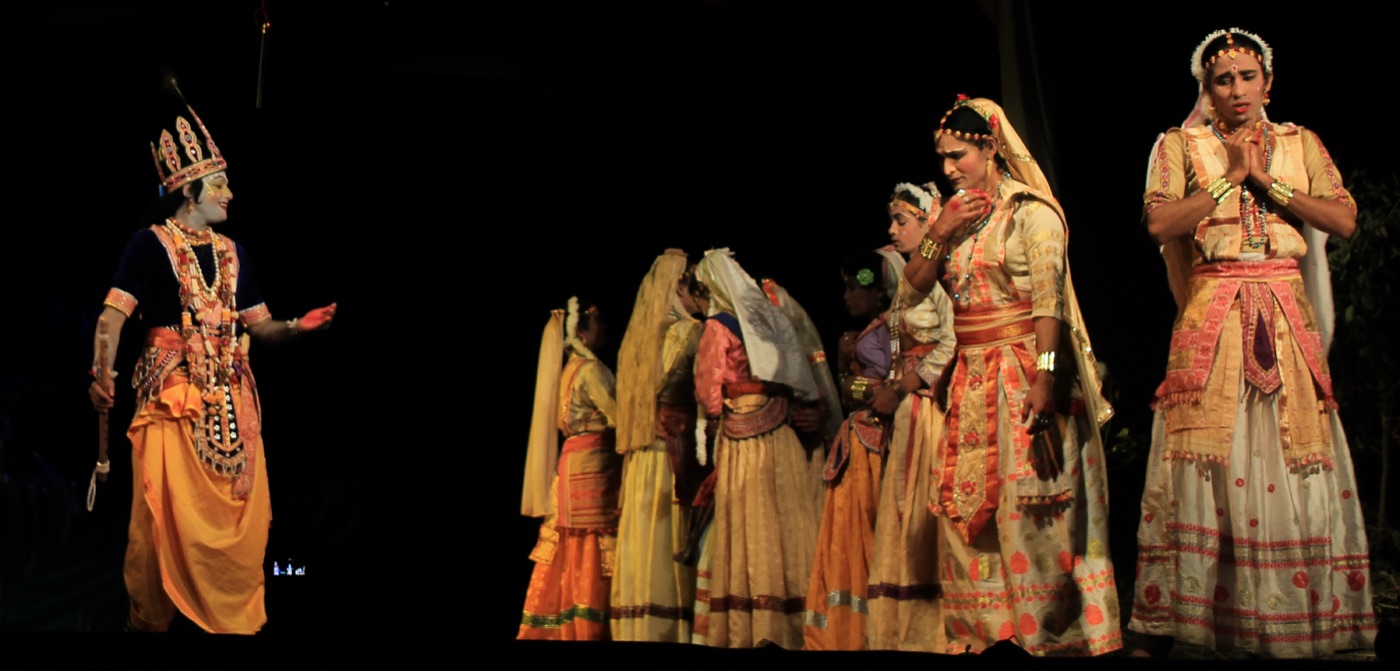
The satras are not only places of prayer. For more than 400 years they have kept alive music, dance, theatre, painting and craft. Sattriya, the dance born in these monasteries, was declared one of India’s classical dances in 2000. Auniati, the satra now under threat, was set up around 1653 with the support of the Ahom king Jayadhwaj Singha. It still keeps old royal objects in gold and ivory.
Majuli once had about 65 satras. Today the count depends on who you ask. A UNESCO review in 2008 mentioned 31 surviving satras. The district office gave a figure of 35 in 2025. Many others have shifted to the mainland, or moved inland on the island, as the river came closer.
The river takes old villages, farms and monasteries, and gives back bare sandbars.
Faces made of bamboo and clay
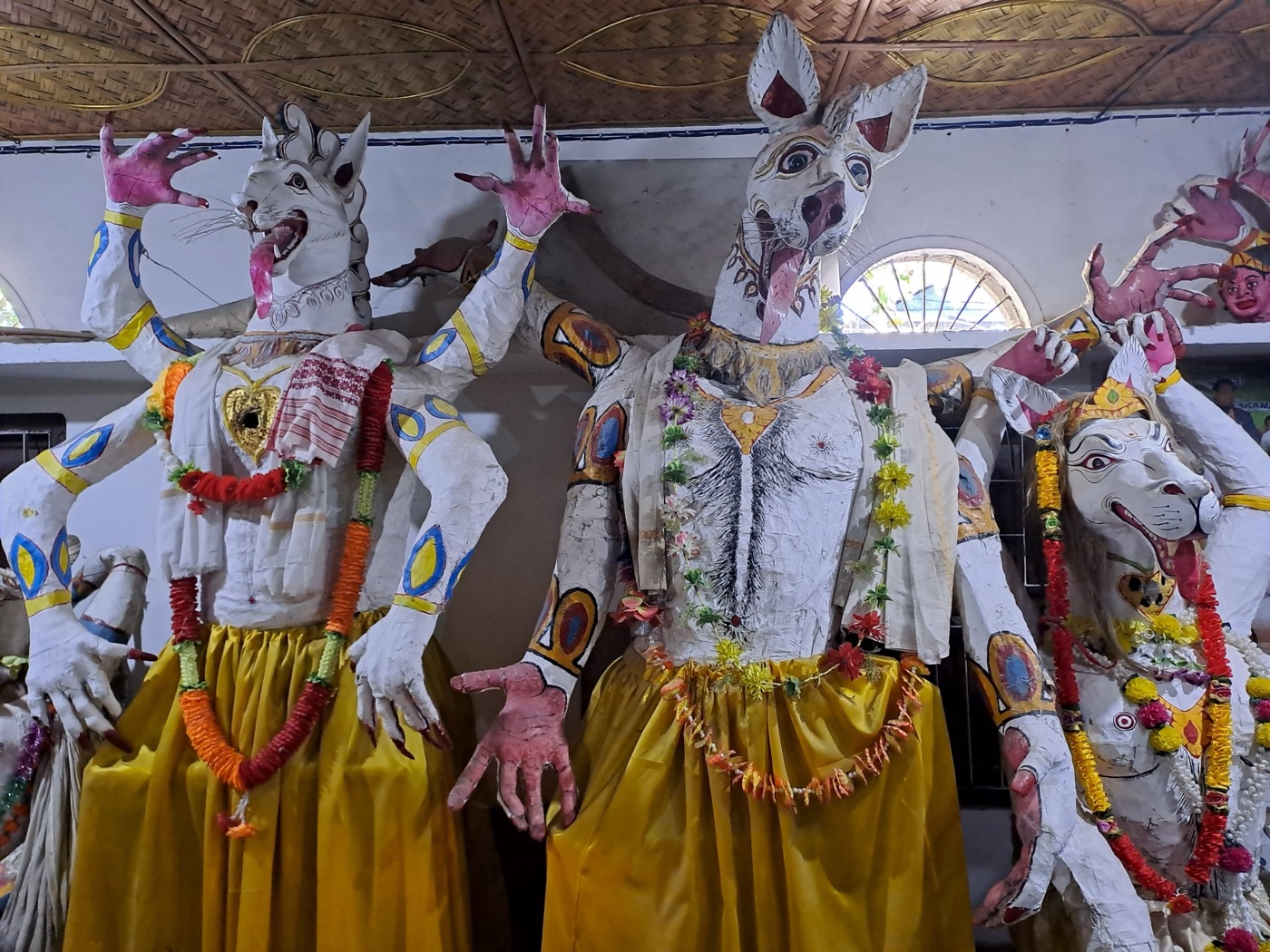
At Samaguri Satra, the walls are lined with faces. Demons with huge teeth, Narasimha with his lion’s mane, Garuda with his beak, Hanuman. These are the masks of Majuli, used in bhaona, the religious plays of the satras.
A mask starts as a frame of split bamboo. Strips of cloth are dipped in clay and laid over it. The surface is smoothed with a paste that includes cow dung, then dried and painted. A single mask can take up to two weeks.
There are three main kinds. The mukh covers only the face. The lotokoi is bigger and reaches the chest, and parts of it can move. The cho mukh is the giant: it covers the actor’s head and body, often down to the waist, and is used for figures like Ravana and Kumbhakarna. Samaguri is also known for masks with moving jaws, so the actor can speak through them.
How much does each mask cover?
Mukh. The everyday mask. It covers only the actor’s face.
Lotokoi. Bigger, reaching down to the chest. Parts of it, like the head or limbs, can move.
Cho mukh. The giant. It swallows the actor’s head and body, often down to the waist. Used for figures like Ravana and Kumbhakarna.
The craft won a GI tag in March 2024, along with Majuli’s manuscript painting on bark. Hem Chandra Goswami of Samaguri, who received the Padma Shri in 2023, has trained students for decades. Women, once kept out of the craft, are now learning it at the Majuli University of Culture.
Living with the water
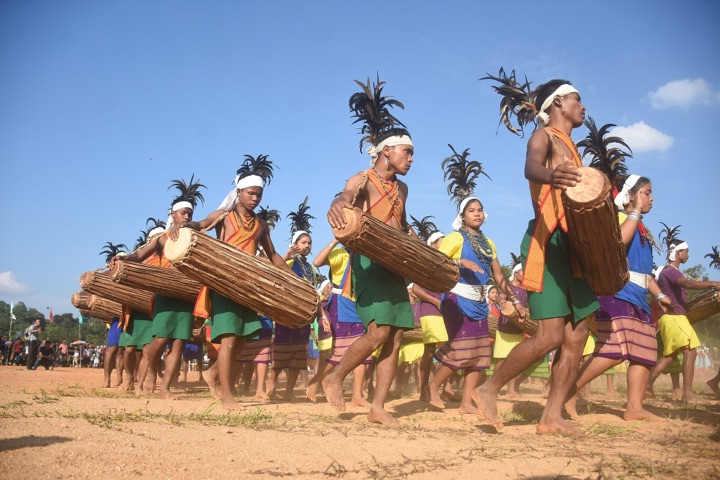
The largest community on Majuli is the Mising, a tribe whose ancestors came down from the hills of Arunachal Pradesh. At the 2011 census, about four in ten islanders spoke Mising as their first language.
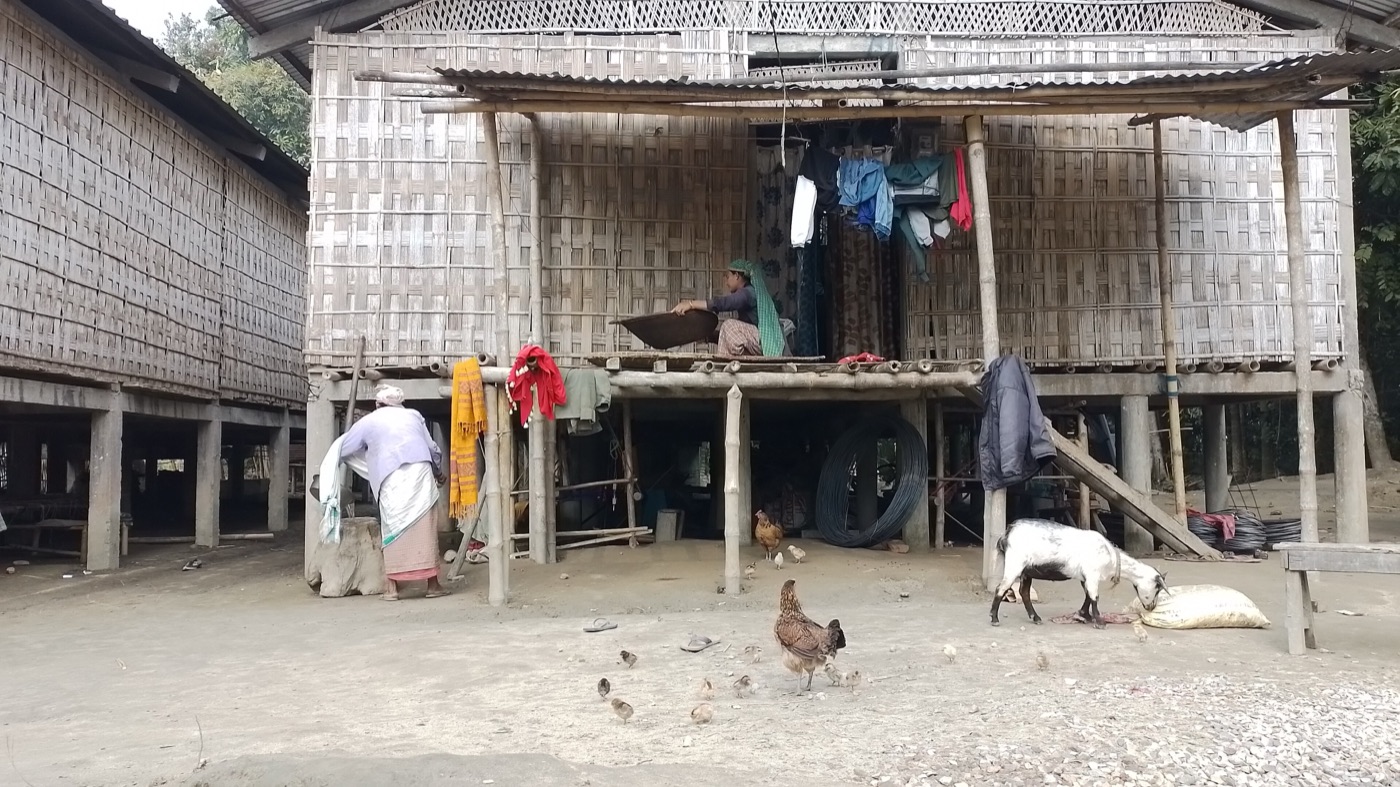
The Mising have lived with floods for generations, and their homes show it. The chang ghar is a house raised on bamboo stilts, often around ten feet high. Floodwater passes underneath instead of pushing against the walls. Cattle, pigs and chickens live below. Granaries stand on stilts too. When the water rises higher one year, families raise the floor the next. In February, Mising villages celebrate Ali-Aye-Ligang, the festival that starts the sowing season.
Other crafts are feeling the squeeze. In Salmora village, women of the Kumar community make pottery the old way, shaping it largely by hand, as their families have since the 16th century. For centuries the men took the pots down the river by boat and traded them for rice. The clay came from the riverbank. Since embankments went up in 2018, digging there is restricted. Some potters now buy clay from the mainland. “We just don’t know if we will have a home tomorrow,” potter Makon Kumar told Al Jazeera last year.
The bridge that keeps getting delayed
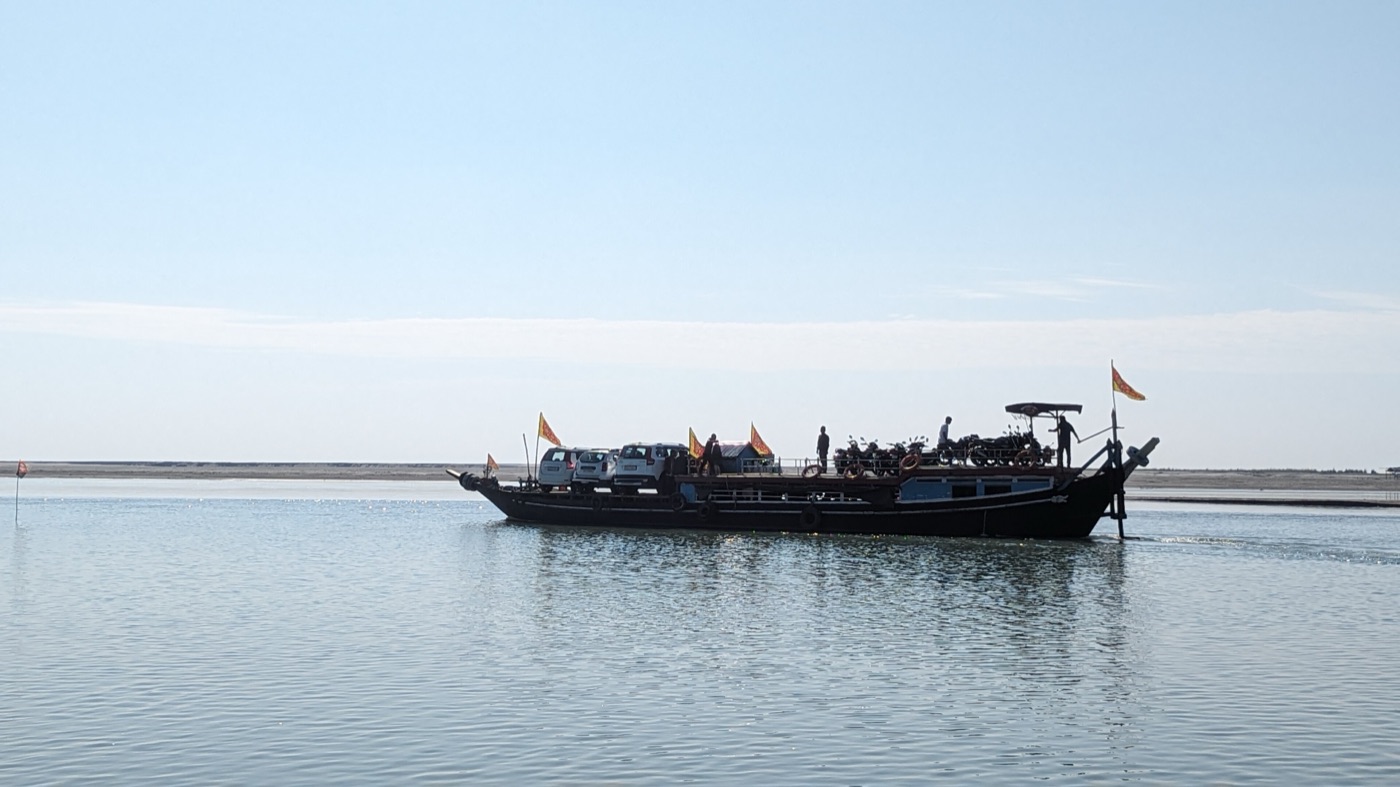
For now, everyone and everything reaches Majuli by boat. A bridge of about 8 km between Jorhat and Majuli was supposed to change that. In 2023, the Chief Minister said it would open by April 2026.
It did not. Work stopped in September 2024 when the contractor walked out over payment disputes. The project was retendered and work restarted in January 2026 with a new company. The government’s project tracker now lists December 2027 as the finish date.
For the island’s craftspeople, the wait matters. Mask maker Pradip Goswami of Samaguri told Al Jazeera that a bridge would help the craft spread. It would also make it easier to sell pots, reach hospitals and get to college on the mainland.
Can Majuli be saved?
Money has been spent. A Rs 233 crore protection scheme was sanctioned in 2017. The Brahmaputra Board is now on its fifth phase, worth about Rs 56 crore, with work at 20 weak spots along the bank. In December 2025, officials said loose soil in some stretches was making the work harder, and ordered new studies. The Bhakat Chapori plan would be on top of all this.
Majuli has also been on UNESCO’s tentative list for World Heritage status since 2004. The bid was sent back in 2006 and put on hold in 2008. UNESCO asked for a proper record of the surviving satras and a plan for floods and climate change. It has not been listed since.
Meanwhile, the island’s wetlands are drying. A Mongabay report in 2024 found that the number of named drainage streams fell from 49 in 1917 to 7 by 1972. Majuli’s wetlands have hosted more than 250 kinds of birds, and one study estimates that about two lakh people in the region depend on wetland fishing.
Why you should go, and when
None of this means you should stay away. The opposite is true. Majuli is at its best from November to March, when the river is calm and the fields are dry. The biggest event of the year is the Raas festival, held around the full moon in November. Over several nights the satras stage the life of Krishna as all-night plays, with masks, music and huge crowds. Garamur Satra’s shows often sell out weeks ahead. Incredible India lists this year’s Raas as 24 to 26 November, but check with the district before you book.
To get there, go to Jorhat and take a taxi or shared auto to Nimati Ghat, about 14 km away. Ferries cross to Kamalabari or Aphalamukh in roughly an hour to an hour and a half. The last boat usually leaves in the mid-afternoon, so start early. Stay in a bamboo homestay in a Mising village, rent a bicycle, and visit the satras slowly. Buy a mask, or a pot from Salmora. Money spent on the island stays with the people trying to keep it alive.
The river has been shaping Majuli for centuries, and it is not going to stop. But the people who live here have always found ways to stay. The bhakats still pray in the namghars. The potters still shape clay by hand. And this week, a monk stood on a crumbling bank and said he would fight for it.